

What Factors Influence a Quantum Care Report?
Introduction
When a person suffers a life-changing injury or develops long-term care needs following clinical negligence or a serious accident, determining the appropriate level of compensation involves much more than assessing the initial injury. It requires a detailed understanding of the individual's current circumstances, future care requirements, rehabilitation potential, and the financial implications of lifelong support.
A quantum care report provides an independent assessment of these needs, helping solicitors, insurers, and the courts calculate damages that accurately reflect the claimant's ongoing care and support requirements. Prepared by an experienced nursing expert, the report examines a wide range of medical, practical, and social factors to ensure recommendations are realistic, evidence-based, and tailored to the individual.
Understanding what influences a quantum care report can help legal professionals appreciate the complexity of future care planning and the importance of obtaining high-quality expert evidence.
What Is a Quantum Care Report?
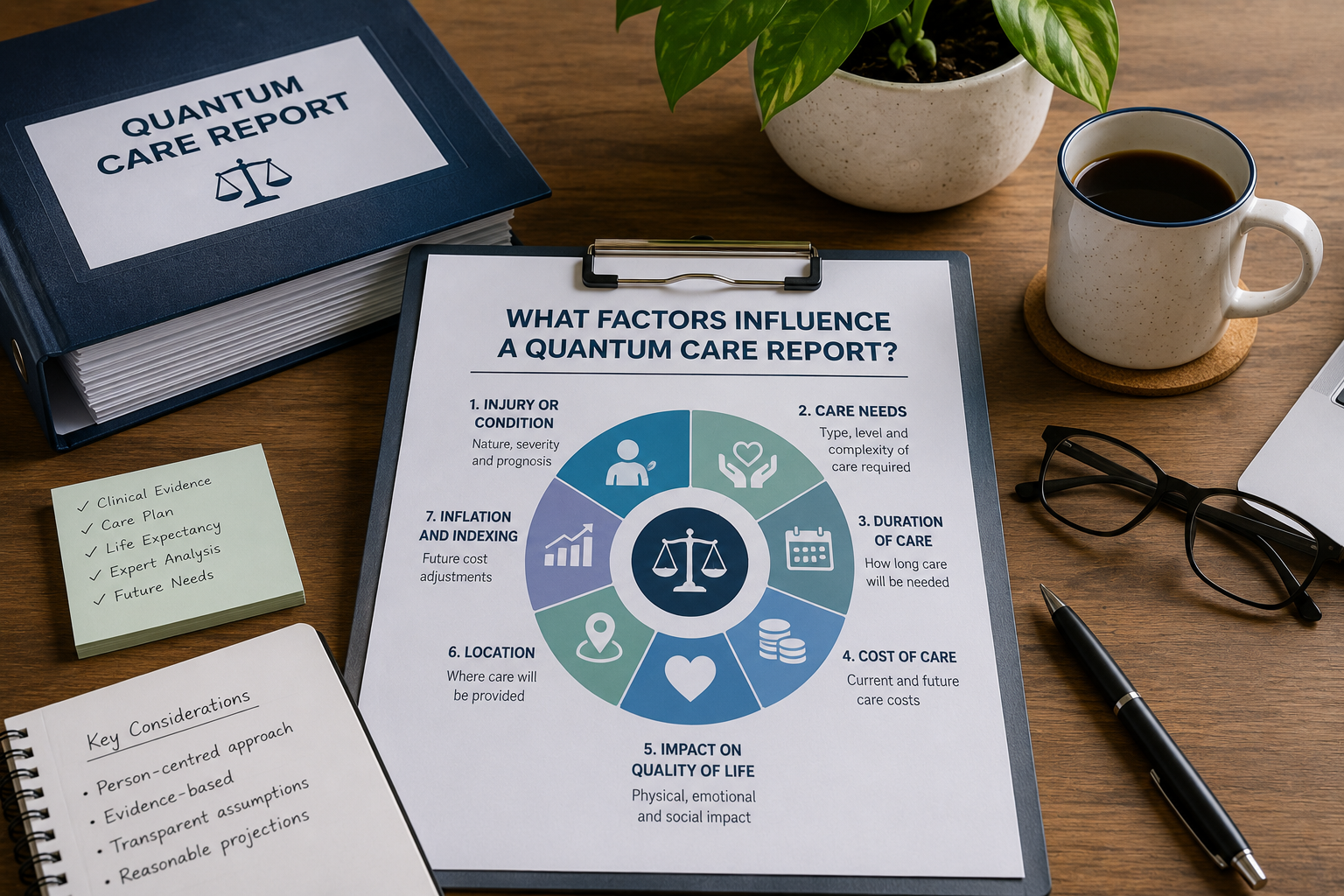
A quantum care report is an expert medico-legal report that evaluates the care, rehabilitation, equipment, accommodation, and support an injured individual is likely to require now and in the future.
Unlike reports that focus solely on liability, a quantum care report concentrates on the financial value of future care. It provides the court with evidence to assist in calculating compensation that will enable the claimant to receive appropriate care throughout their lifetime.
These reports are commonly used in:
Clinical negligence claims
Personal injury litigation
Catastrophic injury cases
Brain injury claims
Spinal cord injury cases
Amputation claims
Serious orthopaedic injuries
Why Every Quantum Care Report Is Different
No two claimants have identical needs. Even individuals with similar injuries may require different levels of care depending on their lifestyle, family circumstances, age, and rehabilitation progress.
For this reason, nursing experts undertake a comprehensive assessment of the individual rather than relying solely on diagnosis.
The report reflects the person's unique circumstances and aims to provide recommendations that are both clinically appropriate and practically achievable.
Medical Condition and Diagnosis
The claimant's medical condition is one of the primary factors influencing the report.
The nursing expert considers:
Nature of the injury
Severity of impairment
Prognosis
Expected recovery
Ongoing symptoms
Associated medical conditions
Some injuries require lifelong nursing support, while others may improve significantly with rehabilitation.
Understanding the likely long-term outlook helps determine future care requirements.
Functional Ability
A diagnosis alone does not determine how much care someone requires.
Instead, nursing experts assess how the injury affects the person's ability to perform everyday activities independently.
This includes evaluating:
Personal Care
Can the individual wash, dress, groom, or use the toilet without assistance?
Mobility
Do they require walking aids, wheelchairs, hoists, or support with transfers?
Household Activities
Can they prepare meals, clean their home, or manage shopping independently?
Communication
Do they require assistance due to speech, cognitive, or sensory difficulties?
Assessing functional ability provides a practical picture of the claimant's daily challenges.
Rehabilitation Potential
Rehabilitation is a key consideration when preparing a quantum care report.
The expert evaluates whether additional therapies could improve independence and reduce long-term care needs.
Recommendations may include:
Physiotherapy
Occupational therapy
Speech and language therapy
Hydrotherapy
Neurorehabilitation
Psychological support
Vocational rehabilitation
Where recovery is expected, future care recommendations may change over time to reflect increasing independence.
Existing Care Arrangements
The nursing expert reviews the care currently being provided.
This may include:
Family support
Professional carers
Community nursing services
Residential care
Live-in care
Personal assistants
The report evaluates whether these arrangements remain appropriate and identifies where additional support may be required.
Family and Social Circumstances
Family members often provide substantial informal care following serious injury.
The nursing expert considers:
Availability of family support
Physical ability of relatives to provide care
Emotional impact on carers
Sustainability of informal care arrangements
Potential need for professional carers
Recognising the contribution of family members is important when estimating future care costs.
Equipment Requirements
Specialist equipment can greatly improve safety, comfort, and independence.
Depending on the claimant's needs, recommendations may include:
Wheelchairs
Pressure-relieving mattresses
Hospital beds
Hoists
Shower chairs
Mobility aids
Communication devices
Specialist seating
Environmental control systems
The report also considers future replacement costs, servicing, and maintenance.
Accommodation Needs
Some claimants require significant adaptations to their home environment.
Recommendations may include:
Ramps
Stairlifts
Accessible bathrooms
Ground-floor living accommodation
Widened doorways
Ceiling track hoists
Specialist kitchen adaptations
Suitable accommodation can reduce care requirements and promote greater independence.
Psychological and Emotional Wellbeing
Serious injury affects more than physical health.
The nursing expert considers how the injury impacts:
Confidence
Anxiety
Depression
Social participation
Relationships
Motivation
Emotional resilience
Where appropriate, recommendations may include counselling, psychological therapy, or specialist mental health support.
Future Care Costs
One of the primary purposes of a quantum care report is to estimate the financial value of future care.
The report may calculate anticipated costs relating to:
Personal care
Nursing care
Rehabilitation
Therapy
Specialist equipment
Accommodation adaptations
Case management
Transport
Replacement equipment
Ongoing healthcare services
These estimates help ensure compensation reflects the claimant's likely lifetime requirements.
Why Independent Expert Evidence Matters
The court relies on expert witnesses to provide balanced, objective opinions that are free from bias.
An experienced nursing expert prepares recommendations based on:
Clinical evidence
Professional expertise
Current best practice
Individual assessment
Realistic future projections
This independent approach gives confidence that care recommendations are fair, proportionate, and evidence-based.
Conclusion
A quantum care report is much more than a calculation of future expenses—it is a comprehensive assessment of how a serious injury affects every aspect of an individual's life. By considering medical evidence, functional ability, rehabilitation potential, family support, accommodation, equipment, and long-term care requirements, nursing experts provide the independent evidence needed to support fair and realistic compensation.
For solicitors, insurers, and the courts, understanding the factors that influence a quantum care report is essential to ensuring that claimants receive the resources they need to maximise independence, enhance quality of life, and access appropriate care throughout the future.
FAQs
What is an expert nurse witness?
An expert nurse witness is a qualified nursing professional who provides independent, impartial opinions in legal cases. Their role is to review clinical records, assess whether accepted standards of nursing care were met, and prepare expert reports for courts, solicitors, insurers, and tribunals.
What does a nursing expert witness do?
A nursing expert witness provides independent opinion on nursing care, standards, practice and professional issues relevant to legal proceedings.
Are you a referral agency or middleman?
No. We are not a referral agency or middleman. Instructions are handled directly by nursing experts within Expert Nurse Witness Group.
Are your experts registered with the Nursing and Midwifery Council?
Yes. All nursing experts within the group are registered with the Nursing and Midwifery Council and work within their professional scope of practice.
Can we request an expert CV?
Yes. We do not publish individual expert profiles as standard, but a relevant expert CV can be provided on request once the instruction has been reviewed and suitability has been confirmed.
Why do you not publish individual expert profiles?
We recognize that our nursing experts have a right to professional privacy and personal data protection. We therefore do not publish individual profiles as standard. This is in line with data protection principles, including only sharing relevant information where there is a clear professional purpose. A relevant CV can be provided on request once suitability has been confirmed.
Do your experts understand their duty to the court?
Yes. Our experts understand that their overriding duty is to the court and that this duty is independent of the party instructing them.
Can you provide mental capacity and best interests reports?
Yes. We can provide nursing expert opinion on mental capacity and best interests matters where the issues fall within nursing expertise.
What is a quantum care report?
A quantum care report evaluates a person's current and future care requirements following injury or illness. It helps quantify care needs for legal proceedings.
Can you provide quantum care reports?
Yes. We can provide quantum care reports, care cost opinions and future care needs reports where the issues fall within nursing expertise and are supported by the evidence.
Do you cover the whole of the UK?
Yes. We provide UK-wide nursing expert witness services, with remote consultations and assessments available where appropriate.
How long does it take to prepare an expert report?
Timeframes vary depending on the complexity of the case and the volume of records. We will provide an estimated turnaround time once instructions have been reviewed.
What happens after I submit an enquiry?
Once we receive your enquiry, we will review the information provided, discuss your requirements if needed, and advise on availability, scope of work, and the next steps.