

Understanding the NMC Fitness to Practise Process
Introduction
The Nursing and Midwifery Council (NMC) plays a vital role in protecting the public by ensuring that nurses, midwives, and nursing associates maintain the professional standards expected of those registered to practise in the United Kingdom. When concerns are raised about a registrant's conduct, competence, health, or professional behaviour, the NMC may begin a Fitness to Practise (FtP) investigation.
Being involved in an NMC investigation can be an unfamiliar and stressful experience for healthcare professionals. The process is often detailed, involving the review of evidence, professional standards, and clinical practice. Understanding how the Fitness to Practise process works can help registrants, employers, solicitors, and legal representatives navigate proceedings with greater confidence.
In complex cases, an independent nursing expert witness may also be instructed to provide an objective opinion on clinical practice, professional standards, and whether the care provided was consistent with what would be expected of a reasonably competent nurse.
What Is Fitness to Practise?
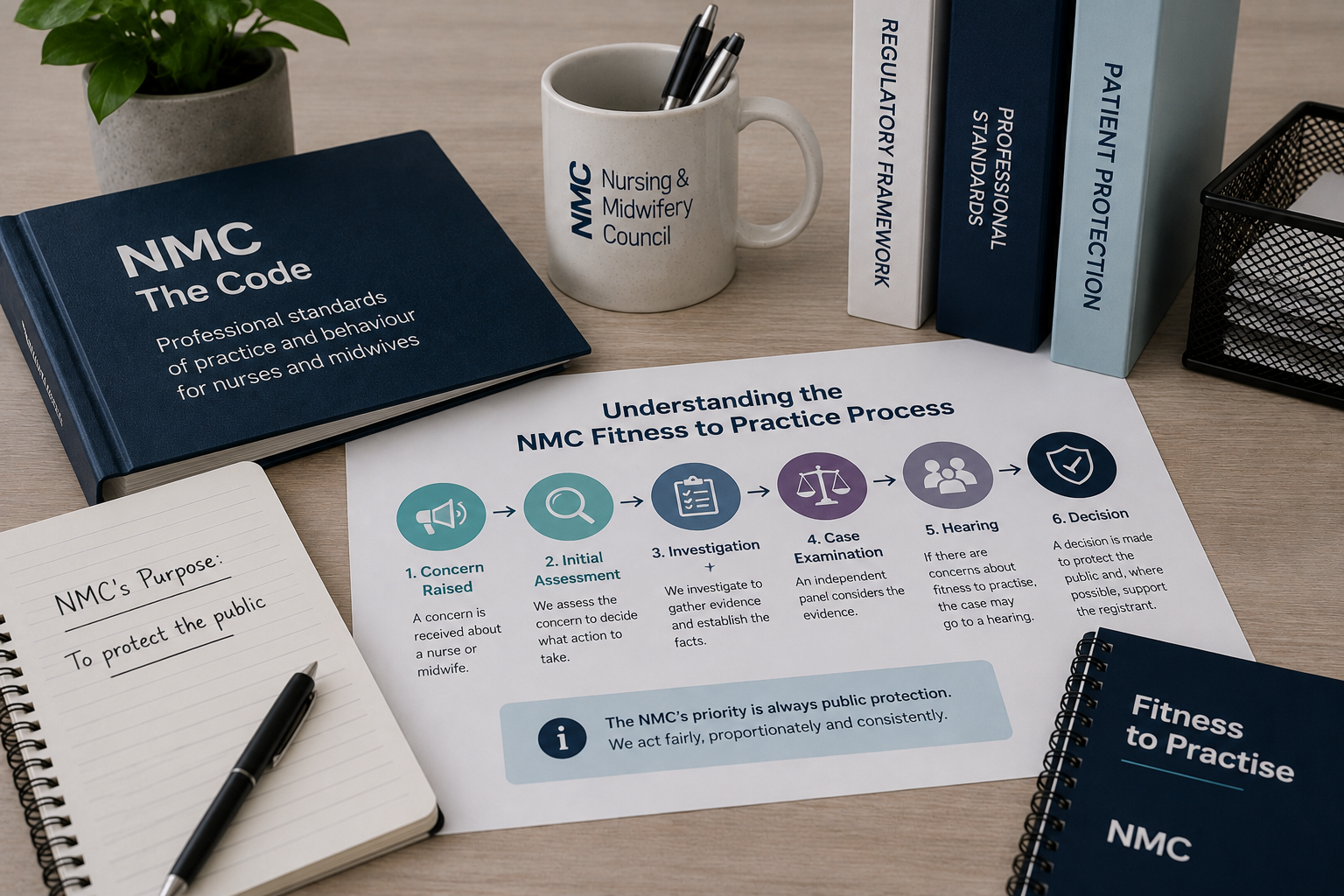
Fitness to Practise refers to whether a registered healthcare professional has the knowledge, skills, health, character, and professional conduct necessary to practise safely and effectively.
The NMC's primary objective is not to punish nurses but to protect the public, maintain confidence in the profession, and uphold professional standards.
An investigation may consider whether a nurse's fitness to practise is impaired because of concerns relating to:
Clinical competence
Professional misconduct
Criminal convictions or cautions
Health conditions affecting practice
Lack of professional knowledge or skills
Poor communication
Dishonesty
Failure to maintain professional standards
Each case is assessed individually based on the available evidence.
How Does the Fitness to Practise Process Begin?
Most Fitness to Practise cases begin when a concern is referred to the NMC.
Referrals may come from:
Employers
Patients
Members of the public
Healthcare professionals
Police or other public bodies
Professional organisations
Self-referrals by registrants
Once a referral is received, the NMC carries out an initial assessment to determine whether the concern falls within its regulatory remit.
Not every referral proceeds to a full investigation.
The Initial Screening Stage
The first stage involves deciding whether the allegation raises concerns that could affect a registrant's fitness to practise.
The NMC considers:
The seriousness of the allegation
Whether there is sufficient evidence
Whether patient safety may be affected
Whether regulatory action is necessary
Some referrals may be closed at this stage if they do not meet the threshold for investigation.
The Investigation Process
Where concerns require further examination, a formal investigation begins.
During this stage, investigators may obtain:
Medical and nursing records
Employer investigation reports
Witness statements
Policies and procedures
Clinical documentation
Professional training records
Incident reports
Correspondence
Expert evidence where appropriate
The registrant is usually given the opportunity to provide their own account and submit supporting evidence.
What Does the NMC Consider?
Each investigation focuses on whether the registrant's actions were consistent with accepted professional standards.
Common issues include:
Clinical Competence
Did the nurse demonstrate appropriate knowledge, skills, and clinical judgment?
Patient Safety
Were patients exposed to unnecessary or avoidable risks?
Record Keeping
Were clinical records accurate, timely, and sufficiently detailed?
Communication
Did communication with patients and colleagues meet professional expectations?
Professional Behaviour
Did the registrant act honestly, ethically, and in accordance with the NMC Code?
The Role of the NMC Code
Throughout the investigation, the NMC Code serves as the benchmark for professional conduct.
The Code sets out expectations relating to:
Prioritising people
Practising effectively
Preserving safety
Promoting professionalism and trust
Independent experts frequently refer to these standards when preparing professional opinions.
When Is an Independent Nursing Expert Witness Required?
Some investigations involve highly specialised clinical issues that require expert interpretation.
An independent nursing expert witness may be instructed to:
Review clinical records
Evaluate nursing practice
Assess compliance with professional standards
Consider whether care met accepted expectations
Prepare an impartial expert report
Provide evidence during hearings if required
The expert's responsibility is not to defend or criticise the registrant but to provide an objective clinical opinion based on evidence.
Possible Outcomes of an Investigation
Following investigation, several outcomes are possible depending on the evidence available.
These may include:
No Further Action
Where there is insufficient evidence or no ongoing impairment.
Advice or Warnings
In some circumstances, concerns may be addressed without formal restrictions.
Conditions of Practice
The nurse may continue practising under specified conditions designed to protect the public.
Suspension
Registration may be suspended for a defined period while concerns are addressed.
Removal from the Register
In the most serious cases, the NMC may order that a registrant be removed from the professional register.
Every decision is based on the evidence presented and the need to protect patients and maintain public confidence.
Preparing for an NMC Investigation
Healthcare professionals involved in Fitness to Practise proceedings should consider:
Seeking independent legal advice
Responding promptly to correspondence
Providing accurate information
Reviewing relevant documentation
Reflecting on clinical practice where appropriate
Cooperating fully with the investigation
Early preparation often helps ensure that the process is managed effectively and professionally.
Why Independent Expert Evidence Matters
Independent nursing expert evidence provides valuable clinical context in complex regulatory cases.
Expert witnesses help by:
Explaining accepted nursing practice
Assessing professional standards objectively
Clarifying complex clinical issues
Supporting fair and evidence-based decision-making
Assisting solicitors and regulatory panels
Their impartial analysis can be particularly valuable where allegations involve specialised areas of nursing practice.
Conclusion
The NMC Fitness to Practise process plays an essential role in maintaining high standards within the nursing profession while protecting patients and preserving public confidence. Although investigations can be challenging for those involved, they are designed to ensure that concerns are assessed fairly, transparently, and with appropriate regard to professional standards.
Independent nursing expert witnesses contribute significantly to this process by providing objective, evidence-based opinions on clinical practice and professional conduct. Their expertise helps solicitors, registrants, regulatory panels, and the courts understand complex nursing issues, ensuring that decisions are informed by current professional standards and sound clinical judgment.
What is an expert nurse witness?
An expert nurse witness is a qualified nursing professional who provides independent, impartial opinions in legal cases. Their role is to review clinical records, assess whether accepted standards of nursing care were met, and prepare expert reports for courts, solicitors, insurers, and tribunals.
What does a nursing expert witness do?
A nursing expert witness provides independent opinion on nursing care, standards, practice and professional issues relevant to legal proceedings.
Are you a referral agency or middleman?
No. We are not a referral agency or middleman. Instructions are handled directly by nursing experts within Expert Nurse Witness Group.
Are your experts registered with the Nursing and Midwifery Council?
Yes. All nursing experts within the group are registered with the Nursing and Midwifery Council and work within their professional scope of practice.
Can we request an expert CV?
Yes. We do not publish individual expert profiles as standard, but a relevant expert CV can be provided on request once the instruction has been reviewed and suitability has been confirmed.
Why do you not publish individual expert profiles?
We recognize that our nursing experts have a right to professional privacy and personal data protection. We therefore do not publish individual profiles as standard. This is in line with data protection principles, including only sharing relevant information where there is a clear professional purpose. A relevant CV can be provided on request once suitability has been confirmed.
Do your experts understand their duty to the court?
Yes. Our experts understand that their overriding duty is to the court and that this duty is independent of the party instructing them.
Can you provide mental capacity and best interests reports?
Yes. We can provide nursing expert opinion on mental capacity and best interests matters where the issues fall within nursing expertise.
What is a quantum care report?
A quantum care report evaluates a person's current and future care requirements following injury or illness. It helps quantify care needs for legal proceedings.
Can you provide quantum care reports?
Yes. We can provide quantum care reports, care cost opinions and future care needs reports where the issues fall within nursing expertise and are supported by the evidence.
Do you cover the whole of the UK?
Yes. We provide UK-wide nursing expert witness services, with remote consultations and assessments available where appropriate.
How long does it take to prepare an expert report?
Timeframes vary depending on the complexity of the case and the volume of records. We will provide an estimated turnaround time once instructions have been reviewed.
What happens after I submit an enquiry?
Once we receive your enquiry, we will review the information provided, discuss your requirements if needed, and advise on availability, scope of work, and the next steps.