

How to Choose the Right Nursing Expert Witness for Your Case
Introduction
Selecting the right nursing expert witness is one of the most important decisions a solicitor can make when handling healthcare-related litigation. Whether the case involves clinical negligence, personal injury, Court of Protection proceedings, professional regulation, or future care needs, the quality of the expert evidence can significantly influence case preparation, negotiations, and court outcomes.
An experienced nursing expert witness provides more than clinical knowledge—they offer an independent, objective opinion that helps legal professionals understand complex nursing issues and present evidence clearly before the court. Choosing an expert with the appropriate qualifications, experience, and medico-legal expertise ensures that reports are robust, reliable, and fully compliant with legal requirements.
This guide outlines the key factors solicitors should consider when selecting a nursing expert witness and explains how the right expert can add value throughout the litigation process.
Why Choosing the Right Expert Matters
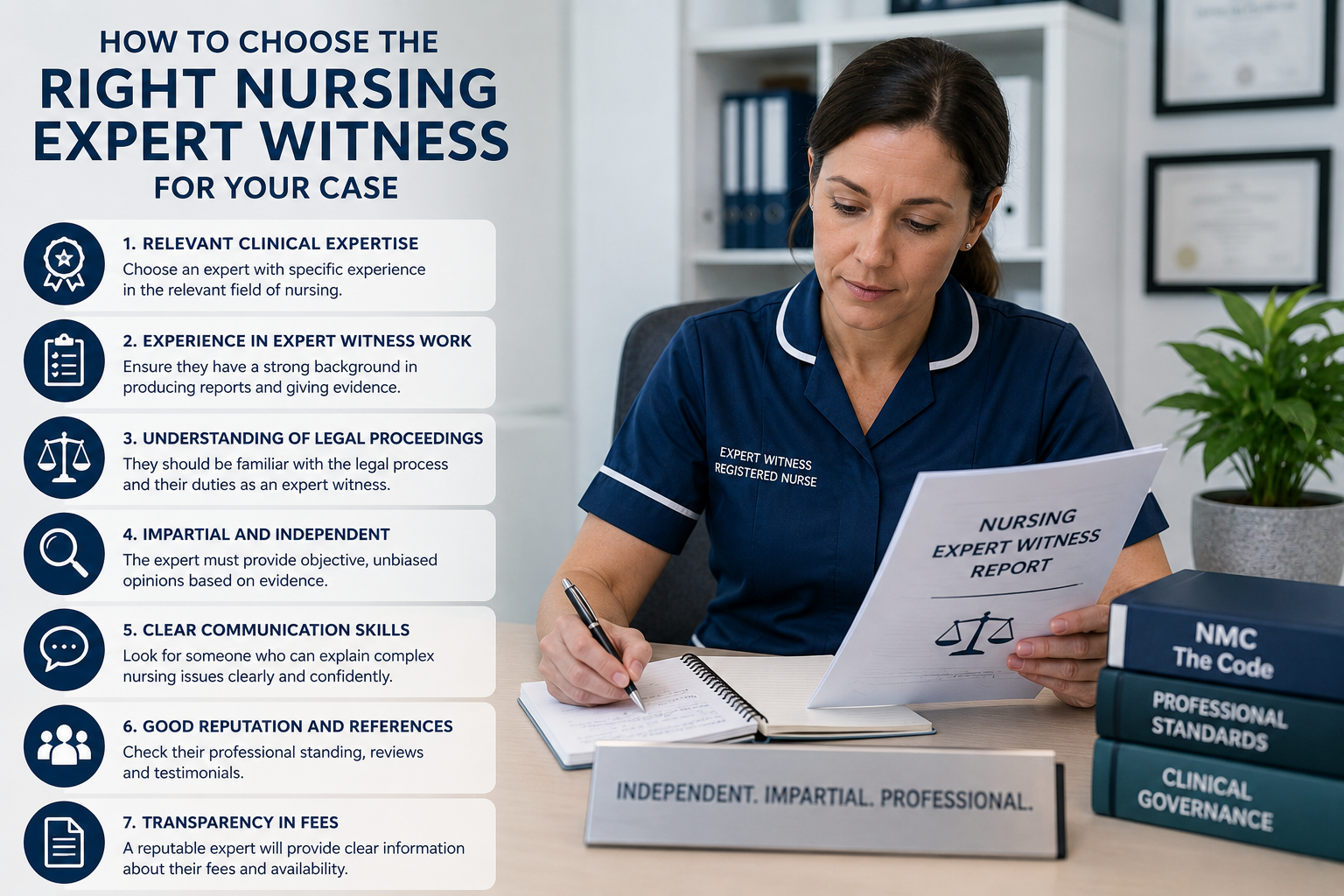
Expert witness evidence often forms a significant part of healthcare litigation. Courts rely on independent experts to explain technical clinical matters that fall outside the knowledge of judges and legal professionals.
An appropriately qualified nursing expert can help:
Clarify complex clinical issues
Assess the standard of nursing care
Identify breaches of professional standards
Evaluate causation where appropriate
Assess future care requirements
Provide objective medico-legal reports
Give oral evidence if required
Selecting the wrong expert may result in unclear reports, unnecessary delays, or evidence that carries less weight during proceedings.
Consider the Expert's Clinical Background
The first consideration should always be whether the expert has relevant clinical expertise.
A nursing expert should have substantial experience in the area of practice relevant to the issues being considered.
For example:
Critical Care
Emergency Nursing
Community Nursing
Mental Health Nursing
Learning Disability Nursing
District Nursing
Care Home Nursing
Rehabilitation Nursing
Tissue Viability
Case Management
Clinical experience should closely match the circumstances of the case wherever possible.
Look for Medico-Legal Experience
Being an excellent nurse does not automatically make someone an effective expert witness.
Solicitors should consider whether the expert has experience preparing reports for legal proceedings and understands the responsibilities associated with expert witness work.
An experienced medico-legal expert should be familiar with:
Civil Procedure Rules (CPR Part 35)
Expert witness duties
Statement of truth requirements
Joint expert meetings
Court procedures
Giving oral evidence
This knowledge helps ensure reports are legally compliant as well as clinically accurate.
Independence and Objectivity
One of the defining characteristics of an expert witness is independence.
Regardless of who instructs them, the expert's primary duty is to assist the court.
A suitable nursing expert should:
Remain impartial
Present balanced opinions
Identify both strengths and weaknesses in the evidence
Avoid advocacy
Base conclusions solely on available evidence
Courts place considerable value on objective expert evidence that is transparent and well-reasoned.
Assess Communication Skills
An expert witness should be able to explain complex nursing concepts in language that is clear and accessible.
Good communication is particularly important because reports are read by:
Solicitors
Barristers
Judges
Insurers
Healthcare professionals
Claimants
Defendants
The best reports avoid unnecessary jargon while still maintaining clinical accuracy.
Evaluate Report Quality
Before instructing an expert, solicitors may wish to review examples of previous medico-legal reports where appropriate.
High-quality reports should be:
Well structured
Logical
Easy to follow
Evidence-based
Clearly referenced
Balanced
Fully compliant with legal requirements
A clear report allows legal teams to understand the expert's reasoning and prepares them for discussions or court proceedings.
Availability and Timescales
Timeliness is often critical in litigation.
Before providing instructions, solicitors should confirm:
Availability
Expected report completion dates
Capacity to review large volumes of records
Availability for conferences
Availability for court attendance if required
Reliable communication and realistic timescales contribute to efficient case management.
Areas Where Nursing Experts Can Assist
Experienced nursing expert witnesses provide opinions across a wide range of legal matters.
These include:
Clinical Negligence
Assessing whether nursing care met accepted professional standards.
Personal Injury
Evaluating rehabilitation requirements and future care needs.
Court of Protection
Providing evidence relating to mental capacity, best interests, and care planning.
Professional Regulation
Reviewing nursing practice during NMC Fitness to Practise proceedings.
Care and Support Assessments
Preparing quantum care reports and future care recommendations.
Choosing an expert with experience relevant to the specific issues under consideration is essential.
Questions Solicitors Should Ask Before Instructing an Expert
Before making a formal instruction, consider asking:
What clinical experience do you have in this specialty?
How long have you worked as an expert witness?
Are you familiar with CPR Part 35 requirements?
Have you previously given evidence in court?
What are your current report turnaround times?
Are there any conflicts of interest?
Do you have availability for conferences or trial if required?
These questions help ensure that the expert is suitable for the case.
Building an Effective Working Relationship
A successful instruction depends on clear communication between the solicitor and expert witness.
Solicitors can support the process by providing:
Clear letters of instruction
Complete medical and nursing records
Relevant witness statements
Court documents
Specific questions requiring expert opinion
Realistic deadlines
Providing comprehensive information at the outset allows the expert to prepare a thorough and efficient report.
The Value of Early Expert Instruction
Many solicitors choose to instruct nursing experts during the early stages of litigation.
Early involvement can help:
Assess case merits
Identify evidential gaps
Clarify liability issues
Support settlement discussions
Improve litigation strategy
Reduce unnecessary costs
Obtaining independent expert advice early often leads to more informed decision-making throughout the case.
Conclusion
Choosing the right nursing expert witness is a crucial part of building a strong healthcare-related legal case. An experienced expert provides objective clinical analysis, explains complex nursing issues clearly, and produces evidence that supports informed legal decision-making.
By considering clinical expertise, medico-legal experience, independence, communication skills, and availability, solicitors can ensure they instruct an expert who is well equipped to assist throughout the litigation process. The right nursing expert witness not only strengthens the quality of evidence but also contributes to efficient case management and fair outcomes for all parties involved.
FAQs
What is an expert nurse witness?
An expert nurse witness is a qualified nursing professional who provides independent, impartial opinions in legal cases. Their role is to review clinical records, assess whether accepted standards of nursing care were met, and prepare expert reports for courts, solicitors, insurers, and tribunals.
What does a nursing expert witness do?
A nursing expert witness provides independent opinion on nursing care, standards, practice and professional issues relevant to legal proceedings.
Are you a referral agency or middleman?
No. We are not a referral agency or middleman. Instructions are handled directly by nursing experts within Expert Nurse Witness Group.
Are your experts registered with the Nursing and Midwifery Council?
Yes. All nursing experts within the group are registered with the Nursing and Midwifery Council and work within their professional scope of practice.
Can we request an expert CV?
Yes. We do not publish individual expert profiles as standard, but a relevant expert CV can be provided on request once the instruction has been reviewed and suitability has been confirmed.
Why do you not publish individual expert profiles?
We recognize that our nursing experts have a right to professional privacy and personal data protection. We therefore do not publish individual profiles as standard. This is in line with data protection principles, including only sharing relevant information where there is a clear professional purpose. A relevant CV can be provided on request once suitability has been confirmed.
Do your experts understand their duty to the court?
Yes. Our experts understand that their overriding duty is to the court and that this duty is independent of the party instructing them.
Can you provide mental capacity and best interests reports?
Yes. We can provide nursing expert opinion on mental capacity and best interests matters where the issues fall within nursing expertise.
What is a quantum care report?
A quantum care report evaluates a person's current and future care requirements following injury or illness. It helps quantify care needs for legal proceedings.
Can you provide quantum care reports?
Yes. We can provide quantum care reports, care cost opinions and future care needs reports where the issues fall within nursing expertise and are supported by the evidence.
Do you cover the whole of the UK?
Yes. We provide UK-wide nursing expert witness services, with remote consultations and assessments available where appropriate.
How long does it take to prepare an expert report?
Timeframes vary depending on the complexity of the case and the volume of records. We will provide an estimated turnaround time once instructions have been reviewed.
What happens after I submit an enquiry?
Once we receive your enquiry, we will review the information provided, discuss your requirements if needed, and advise on availability, scope of work, and the next steps.