

Understanding the Principles of the Mental Capacity Act
Introduction
The Mental Capacity Act (MCA) provides the legal framework for making decisions on behalf of adults who may lack the capacity to make certain decisions for themselves. It aims to protect vulnerable individuals while empowering them to make their own choices wherever possible.
For healthcare professionals, solicitors, local authorities, and the courts, understanding the principles of the Mental Capacity Act is essential. The Act guides decisions relating to healthcare, finances, accommodation, welfare, and long-term care, ensuring that individuals' rights, dignity, and independence remain at the centre of decision-making.
Independent nursing expert witnesses are often instructed in cases involving mental capacity assessments, best interests decisions, and Court of Protection proceedings. Their expertise helps clarify complex clinical issues and provides objective evidence that supports lawful and person-centred decision-making.
What Is the Mental Capacity Act?
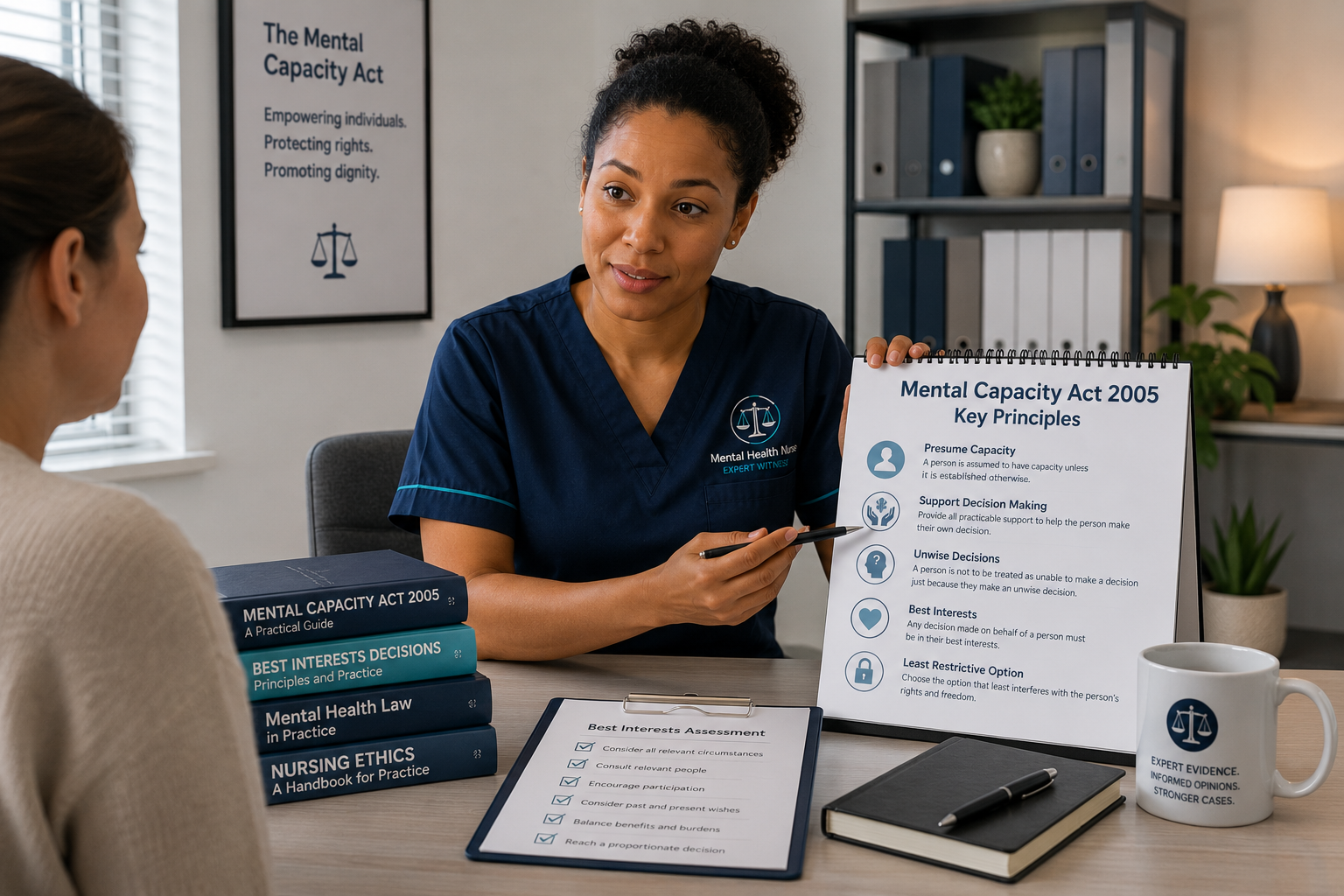
The Mental Capacity Act 2005 is legislation in England and Wales that protects adults aged 16 and over who may be unable to make certain decisions because of an impairment or disturbance affecting the functioning of their mind or brain.
The Act applies to a wide range of situations, including decisions about:
Medical treatment
Personal care
Living arrangements
Financial matters
Social care
Long-term support
Serious healthcare interventions
Importantly, the Act does not assume that a person lacks capacity simply because they have a diagnosis such as dementia, learning disability, brain injury, or mental illness. Capacity must always be assessed in relation to the specific decision that needs to be made.
The Five Principles of the Mental Capacity Act
The Mental Capacity Act is built around five key principles that guide every assessment and decision.
1. Presumption of Capacity
Every adult should be presumed to have capacity unless it is established otherwise.
Healthcare professionals must not assume that someone lacks capacity simply because they appear confused, have a disability, or make decisions others consider unwise.
2. Support Individuals to Make Their Own Decisions
Before concluding that someone lacks capacity, every practical effort should be made to help them make their own decision.
Support may include:
Using simple language
Providing written or visual information
Allowing extra time
Using interpreters or communication aids
Choosing the best time of day for discussions
The aim is always to maximise independence wherever possible.
3. People Have the Right to Make Unwise Decisions
A person should not automatically be considered incapable simply because they make a decision that others disagree with.
Individuals are entitled to make choices that involve risk, provided they understand the consequences of those decisions.
This principle helps protect personal autonomy and individual freedom.
4. Best Interests
If a person lacks capacity for a specific decision, any action taken or decision made on their behalf must be in their best interests.
Best interests decisions involve considering:
The person's wishes and preferences
Their beliefs and values
Previous decisions they have made
The views of family members and carers
Professional opinions
Available treatment or care options
5. Choose the Least Restrictive Option
Whenever possible, decisions should interfere as little as possible with the person's rights and freedoms.
Professionals should always consider whether there is a less restrictive way of achieving the same outcome.
How Is Mental Capacity Assessed?
Capacity assessments are both decision-specific and time-specific.
This means a person may have capacity to make one decision but not another, and their capacity may change over time.
The assessment generally considers whether the person can:
Understand Information
Can they understand the information relevant to the decision?
Retain Information
Can they remember that information long enough to make the decision?
Use or Weigh Information
Can they consider the advantages, disadvantages, and consequences of different options?
Communicate Their Decision
Can they communicate their choice verbally, in writing, through sign language, or by any other means?
Failure in one or more of these areas may indicate that the individual lacks capacity for that specific decision.
When Are Capacity Assessments Required?
Capacity assessments may be required in many healthcare and legal situations, including:
Consent to medical treatment
Hospital discharge planning
Decisions regarding residential care
Serious medical procedures
Financial management
Court of Protection applications
Safeguarding investigations
Long-term care planning
Each assessment should be carefully documented and based on the individual's circumstances at that particular time.
The Role of Nursing Experts
Independent nursing experts frequently assist in cases involving mental capacity and best interests.
Their responsibilities may include:
Reviewing medical and nursing records
Assessing care documentation
Evaluating previous capacity assessments
Providing independent opinions
Preparing expert witness reports
Advising solicitors and the courts
Giving evidence during legal proceedings when required
Because they have extensive clinical experience, nursing experts can explain how a person's health condition affects their ability to make decisions and whether appropriate procedures have been followed.
Best Interests Decision-Making
When someone lacks capacity, professionals must determine what course of action best promotes the person's welfare.
Best interests assessments are not based solely on medical opinion.
Decision-makers should consider:
The person's own wishes
Family views
Cultural beliefs
Religious values
Emotional wellbeing
Future preferences where known
Clinical recommendations
Every effort should be made to involve the individual as much as possible throughout the process.
The Importance of Accurate Documentation
Clear documentation is essential during capacity assessments.
Records should demonstrate:
Why the assessment was required
Who completed the assessment
How the assessment was conducted
The evidence supporting the conclusion
Discussions with family members
The reasoning behind best interests decisions
Comprehensive documentation provides transparency and assists legal professionals if decisions are later challenged.
How Expert Evidence Supports Court Proceedings
Court of Protection cases often involve complex medical and ethical questions.
Independent nursing expert witnesses help the court by:
Explaining healthcare issues clearly
Assessing nursing care objectively
Evaluating decision-making processes
Reviewing best interests considerations
Providing impartial clinical opinions
Their reports support fair, lawful, and evidence-based judicial decisions.
Conclusion
The Mental Capacity Act provides an essential legal framework that balances the protection of vulnerable adults with the preservation of individual rights and autonomy. By following its five guiding principles, healthcare professionals can ensure that decisions are lawful, person-centred, and made with respect for the individual's wishes and wellbeing.
Independent nursing expert witnesses play an important role in supporting this process by providing objective clinical assessments, reviewing complex evidence, and assisting courts, solicitors, and healthcare organisations in reaching informed decisions. Their expertise helps ensure that mental capacity and best interests cases are managed fairly, compassionately, and in accordance with the law.
FAQs
What is an expert nurse witness?
An expert nurse witness is a qualified nursing professional who provides independent, impartial opinions in legal cases. Their role is to review clinical records, assess whether accepted standards of nursing care were met, and prepare expert reports for courts, solicitors, insurers, and tribunals.
What does a nursing expert witness do?
A nursing expert witness provides independent opinion on nursing care, standards, practice and professional issues relevant to legal proceedings.
Are you a referral agency or middleman?
No. We are not a referral agency or middleman. Instructions are handled directly by nursing experts within Expert Nurse Witness Group.
Are your experts registered with the Nursing and Midwifery Council?
Yes. All nursing experts within the group are registered with the Nursing and Midwifery Council and work within their professional scope of practice.
Can we request an expert CV?
Yes. We do not publish individual expert profiles as standard, but a relevant expert CV can be provided on request once the instruction has been reviewed and suitability has been confirmed.
Why do you not publish individual expert profiles?
We recognize that our nursing experts have a right to professional privacy and personal data protection. We therefore do not publish individual profiles as standard. This is in line with data protection principles, including only sharing relevant information where there is a clear professional purpose. A relevant CV can be provided on request once suitability has been confirmed.
Do your experts understand their duty to the court?
Yes. Our experts understand that their overriding duty is to the court and that this duty is independent of the party instructing them.
Can you provide mental capacity and best interests reports?
Yes. We can provide nursing expert opinion on mental capacity and best interests matters where the issues fall within nursing expertise.
What is a quantum care report?
A quantum care report evaluates a person's current and future care requirements following injury or illness. It helps quantify care needs for legal proceedings.
Can you provide quantum care reports?
Yes. We can provide quantum care reports, care cost opinions and future care needs reports where the issues fall within nursing expertise and are supported by the evidence.
Do you cover the whole of the UK?
Yes. We provide UK-wide nursing expert witness services, with remote consultations and assessments available where appropriate.
How long does it take to prepare an expert report?
Timeframes vary depending on the complexity of the case and the volume of records. We will provide an estimated turnaround time once instructions have been reviewed.
What happens after I submit an enquiry?
Once we receive your enquiry, we will review the information provided, discuss your requirements if needed, and advise on availability, scope of work, and the next steps.