

Understanding the Standard of Care in Modern Nursing Practice
Introduction
The standard of care is one of the most important concepts in modern healthcare and is central to many clinical negligence claims. Every registered nurse has a professional duty to provide safe, effective, compassionate, and evidence-based care that meets recognised professional standards.
When concerns arise about the quality of nursing care, legal professionals, healthcare organisations, and regulatory bodies often need to determine whether the care provided met the standard reasonably expected of a competent nursing professional working in similar circumstances. This assessment forms the foundation of many clinical negligence investigations.
Understanding what constitutes an appropriate standard of care helps healthcare professionals maintain safe practice while also assisting solicitors, insurers, and courts in evaluating allegations of negligence. Independent nursing expert witnesses play a crucial role in assessing these standards objectively and providing evidence-based opinions.
What Is the Nursing Standard of Care?
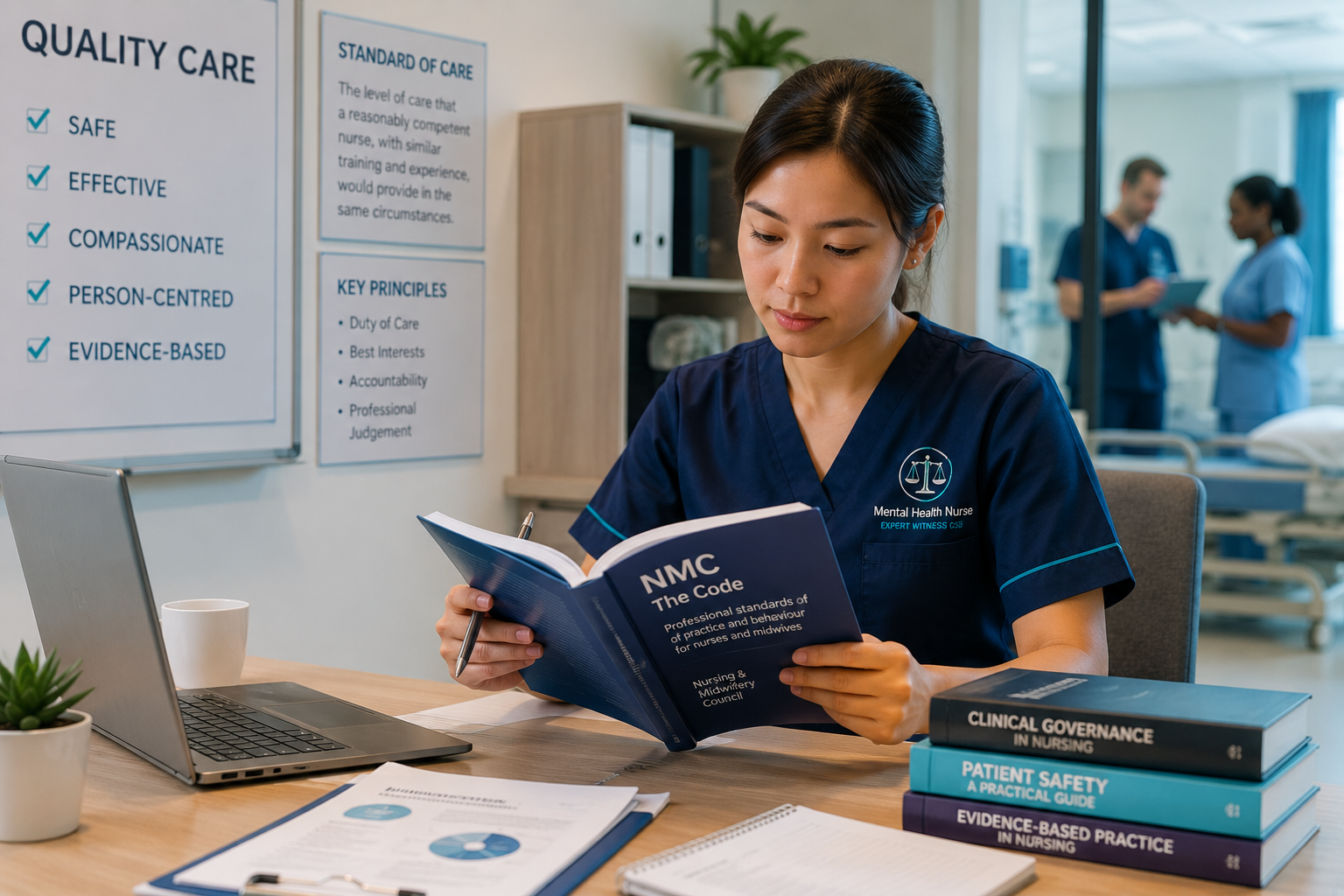
The nursing standard of care refers to the level of competence, skill, judgment, and professionalism that a reasonably competent nurse is expected to demonstrate while caring for patients.
Rather than expecting perfection, the law recognises that nurses work in challenging environments where clinical decisions must often be made quickly. However, patients are entitled to receive care that reflects accepted professional practice and current clinical knowledge.
The expected standard of care is influenced by several factors, including:
Professional education and training
Current evidence-based practice
National clinical guidelines
Employer policies and procedures
Professional codes of conduct
The nurse's level of responsibility and experience
The clinical setting and available resources
These factors provide the framework against which nursing care may later be assessed if concerns arise.
Why Professional Standards Matter
Maintaining high professional standards protects patients, supports healthcare teams, and promotes public confidence in the nursing profession.
Good nursing practice contributes to:
Improved patient safety
Better clinical outcomes
Effective communication between healthcare professionals
Reduced clinical risk
Accurate continuity of care
Greater patient confidence
Lower likelihood of complaints or litigation
Conversely, poor nursing practice may expose patients to avoidable harm and increase the likelihood of legal claims or regulatory investigations.
The Professional Responsibilities of Nurses
Registered nurses are expected to deliver care that is safe, compassionate, person-centred, and evidence-based.
This includes responsibilities such as:
Comprehensive Patient Assessment
Nurses should perform appropriate assessments, identify potential risks, and recognise deterioration promptly.
Clinical Monitoring
Patients should be observed appropriately, with abnormal findings accurately documented and escalated without delay.
Safe Medication Administration
Medicines must be administered in accordance with prescriptions, organisational policies, and recognised safety procedures.
Accurate Documentation
Clear, factual, and timely record keeping is an essential professional responsibility that supports safe patient care and legal accountability.
Effective Communication
Nurses should communicate clearly with patients, relatives, colleagues, and members of the multidisciplinary team.
Safeguarding Patients
Protecting vulnerable adults and children remains a fundamental aspect of professional nursing practice.
Common Situations Where Standards of Care Are Questioned
Independent nursing experts are frequently instructed to review cases involving concerns about nursing care.
Some of the most common issues include:
Pressure Ulcer Prevention
Questions may arise regarding whether appropriate risk assessments were completed, repositioning schedules were followed, and skin integrity was monitored.
Falls Prevention
Experts may assess whether appropriate falls risk assessments, supervision, and preventative measures were implemented.
Medication Errors
These cases often involve incorrect dosages, omitted medication, delayed administration, or failures in documentation.
Failure to Recognise Patient Deterioration
Prompt recognition of clinical deterioration is essential. Delays in escalation may significantly affect patient outcomes.
Poor Documentation
Incomplete or inaccurate nursing records can make it difficult to demonstrate that appropriate care was provided.
Communication Failures
Breakdowns in communication between healthcare professionals can contribute to adverse patient outcomes.
How Nursing Standards Are Assessed
When reviewing a case, an independent nursing expert considers whether the care provided was consistent with what would reasonably be expected from a competent nurse in similar circumstances.
The assessment usually involves reviewing:
Hospital records
Nursing documentation
Care plans
Observation charts
Medication records
Incident reports
Local policies
National guidance
Professional standards
Witness statements
The expert carefully compares the documented care against recognised standards before forming an independent opinion.
The Role of Evidence-Based Practice
Modern nursing practice is continually evolving. Nurses are expected to keep their knowledge and skills up to date through continuing professional development and by following current evidence-based guidance.
Evidence-based practice combines:
The best available research
Clinical expertise
Professional judgment
Patient preferences and individual circumstances
This approach promotes consistency, improves patient outcomes, and supports high-quality healthcare delivery.
When Does Poor Care Become Clinical Negligence?
Not every adverse outcome results from negligence. Patients may experience complications despite receiving appropriate care.
Clinical negligence generally requires evidence that:
A duty of care existed.
The standard of care fell below what would reasonably be expected.
The breach contributed to the patient's injury or harm.
Determining whether these elements are present often requires independent expert evidence.
The Importance of Independent Nursing Expert Witnesses
Independent nursing expert witnesses assist legal professionals by providing impartial assessments of nursing care.
Their role includes:
Reviewing medical and nursing records
Analysing clinical decision-making
Assessing professional standards
Explaining complex nursing issues clearly
Preparing expert witness reports
Providing evidence in court where required
Because their overriding duty is to the court, nursing experts must provide objective opinions supported by evidence rather than advocacy.
Improving Nursing Standards Through Learning
Clinical negligence investigations can also provide valuable learning opportunities for healthcare organisations.
Reviewing incidents helps organisations:
Improve patient safety
Strengthen clinical governance
Enhance staff education
Update policies and procedures
Reduce future clinical risks
Promote continuous quality improvement
Learning from previous cases contributes to safer healthcare for future patients.
Conclusion
The nursing standard of care underpins every aspect of professional nursing practice and plays a central role in maintaining patient safety, public confidence, and legal accountability. By following evidence-based practice, maintaining accurate records, communicating effectively, and delivering compassionate care, nurses help ensure positive outcomes for the patients they serve.
When concerns arise regarding the quality of nursing care, independent nursing expert witnesses provide valuable, objective opinions that assist solicitors, insurers, healthcare organisations, and the courts in understanding whether professional standards have been met. Their expertise helps ensure that clinical negligence cases are assessed fairly, transparently, and on the basis of sound clinical evidence.
FAQs
What is an expert nurse witness?
An expert nurse witness is a qualified nursing professional who provides independent, impartial opinions in legal cases. Their role is to review clinical records, assess whether accepted standards of nursing care were met, and prepare expert reports for courts, solicitors, insurers, and tribunals.
What does a nursing expert witness do?
A nursing expert witness provides independent opinion on nursing care, standards, practice and professional issues relevant to legal proceedings.
Are you a referral agency or middleman?
No. We are not a referral agency or middleman. Instructions are handled directly by nursing experts within Expert Nurse Witness Group.
Are your experts registered with the Nursing and Midwifery Council?
Yes. All nursing experts within the group are registered with the Nursing and Midwifery Council and work within their professional scope of practice.
Can we request an expert CV?
Yes. We do not publish individual expert profiles as standard, but a relevant expert CV can be provided on request once the instruction has been reviewed and suitability has been confirmed.
Why do you not publish individual expert profiles?
We recognize that our nursing experts have a right to professional privacy and personal data protection. We therefore do not publish individual profiles as standard. This is in line with data protection principles, including only sharing relevant information where there is a clear professional purpose. A relevant CV can be provided on request once suitability has been confirmed.
Do your experts understand their duty to the court?
Yes. Our experts understand that their overriding duty is to the court and that this duty is independent of the party instructing them.
Can you provide mental capacity and best interests reports?
Yes. We can provide nursing expert opinion on mental capacity and best interests matters where the issues fall within nursing expertise.
What is a quantum care report?
A quantum care report evaluates a person's current and future care requirements following injury or illness. It helps quantify care needs for legal proceedings.
Can you provide quantum care reports?
Yes. We can provide quantum care reports, care cost opinions and future care needs reports where the issues fall within nursing expertise and are supported by the evidence.
Do you cover the whole of the UK?
Yes. We provide UK-wide nursing expert witness services, with remote consultations and assessments available where appropriate.
How long does it take to prepare an expert report?
Timeframes vary depending on the complexity of the case and the volume of records. We will provide an estimated turnaround time once instructions have been reviewed.
What happens after I submit an enquiry?
Once we receive your enquiry, we will review the information provided, discuss your requirements if needed, and advise on availability, scope of work, and the next steps.