

How Quantum Care Reports Assess Future Care Needs After Serious Injury
Introduction
When an individual experiences a serious injury, illness, or life-changing condition, understanding their future care requirements is essential for ensuring they receive the appropriate level of support.
A quantum care report provides an independent assessment of an individual’s current and future care needs, helping legal professionals, insurers, and courts understand the practical impact of an injury and the resources required to support the person moving forward.
Unlike standard medical reports that focus primarily on diagnosis and treatment, quantum care assessments consider the wider impact of a condition, including daily living requirements, rehabilitation, specialist support, equipment needs, and long-term care arrangements.
Prepared by an experienced nursing expert, a quantum care report provides evidence-based recommendations that help establish the level of care required and assist in calculating appropriate compensation in personal injury and clinical negligence claims.
What Is a Quantum Care Report?
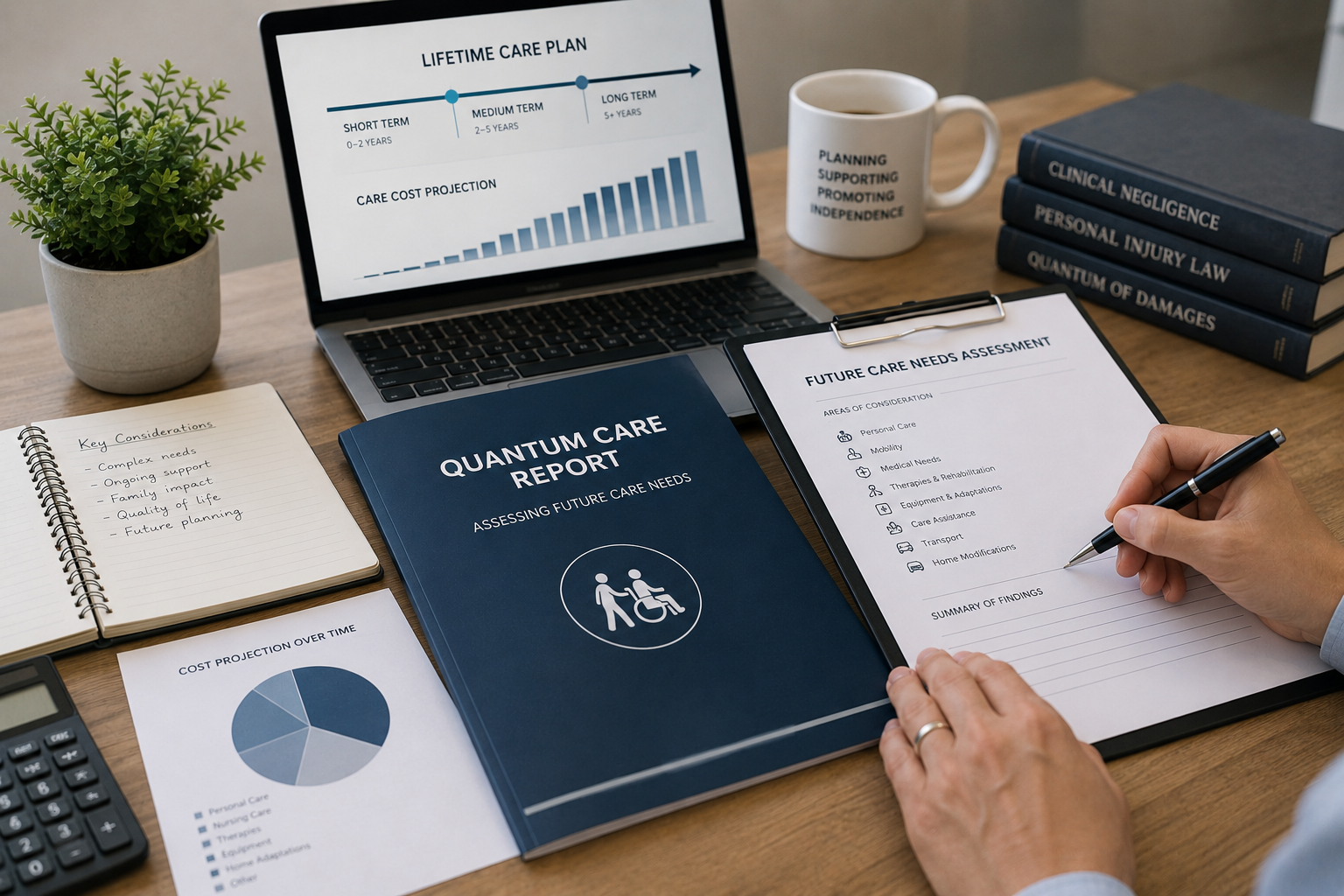
A quantum care report is a specialist medico-legal assessment that evaluates an individual’s present and future care needs following injury, illness, or disability.
The purpose of the report is to provide an objective opinion regarding the type and amount of care required to support the individual’s health, safety, independence, and quality of life.
A quantum care report may consider:
Current care arrangements
Future nursing requirements
Rehabilitation needs
Assistance with daily activities
Specialist equipment
Home adaptations
Care support costs
Long-term health management
The report allows legal teams and courts to understand the practical consequences of an injury beyond the initial medical treatment.
Why Quantum Care Reports Are Important in Legal Claims
In serious injury and clinical negligence cases, compensation is often required to cover future care and support.
Without detailed expert assessment, it can be difficult to determine:
How much care an individual will require
Whether professional carers or nurses are needed
What equipment may be necessary
Whether care needs will increase over time
What financial support will be required in the future
A quantum care report provides independent evidence to help ensure that future needs are properly considered.
This is particularly important in cases involving:
Brain injuries
Spinal injuries
Neurological conditions
Serious accidents
Birth injuries
Complex disabilities
Long-term health conditions
The Role of a Nursing Expert in Quantum Care Assessments
A nursing expert witness brings clinical experience and specialist knowledge when assessing future care requirements.
Their role involves reviewing medical evidence, understanding the individual’s condition, and evaluating how their injury affects everyday life.
The expert may assess:
Current Care Requirements
The assessment begins by examining the individual’s existing care arrangements.
This may include:
Personal care support
Medication assistance
Mobility support
Clinical monitoring
Rehabilitation services
Family-provided care
Understanding current needs provides the foundation for predicting future requirements.
Future Nursing and Support Needs
A key part of a quantum care report is assessing how care requirements may change over time.
The expert considers factors such as:
The nature of the injury
Expected recovery outcomes
Long-term prognosis
Age and life expectancy
Risk of complications
Increasing care dependency
The report provides recommendations based on clinical evidence and professional judgement.
Assessing Different Types of Future Care
Future care needs can vary significantly depending on the individual’s circumstances.
A quantum care report may consider several areas of support.
Nursing Care Requirements
Some individuals may require ongoing specialist nursing support due to complex medical needs.
This may include:
Wound management
Medication management
Clinical observations
Continence care
Management of medical equipment
Monitoring of chronic conditions
A nursing expert can assess the level of support required and whether specialist skills are necessary.
Personal Care and Daily Living Support
Serious injuries may affect an individual’s ability to complete everyday activities independently.
A report may assess assistance required with:
Washing and dressing
Eating and drinking
Personal hygiene
Communication
Household tasks
Community activities
The assessment considers how much support is required to maintain independence and wellbeing.
Rehabilitation and Therapy Needs
Recovery following serious injury often requires ongoing rehabilitation.
Quantum care reports may consider the need for:
Physiotherapy
Occupational therapy
Speech and language therapy
Psychological support
Specialist rehabilitation programmes
These services can play an important role in maximising independence and improving quality of life.
Equipment and Adaptation Requirements
Some individuals may require specialist equipment or changes to their living environment.
A quantum care assessment may identify requirements such as:
Mobility aids
Specialist beds
Wheelchairs
Hoists
Bathroom adaptations
Home modifications
Communication equipment
These recommendations help ensure that the individual’s environment supports their health and safety.
How Quantum Care Reports Support Personal Injury Claims
In personal injury litigation, understanding future care requirements is essential when calculating compensation.
A quantum care report helps provide evidence regarding:
The level of support required
The duration of care needs
The involvement of family carers
Future rehabilitation requirements
Expected care-related expenses
This information assists solicitors, insurers, and courts in reaching a fair assessment of damages.
The Importance of Accurate Future Care Assessment
An inaccurate assessment of future needs can result in an individual receiving insufficient support or resources that do not reflect their actual circumstances.
A detailed quantum care report ensures that future requirements are considered realistically.
A comprehensive assessment should consider:
Individual Circumstances
Every person’s needs are different. The report should reflect the individual’s lifestyle, condition, goals, and environment.
Evidence-Based Recommendations
Recommendations should be supported by clinical evidence, medical records, and professional expertise.
Long-Term Considerations
Future changes in health, ageing, and potential complications should be considered.
Practical Support Needs
The report should focus on the real-life impact of the injury and the assistance required.
Why Early Instruction of a Quantum Care Expert Is Beneficial
Obtaining expert nursing input early can help legal teams better understand the long-term implications of an injury.
Early assessment can assist with:
Case Preparation
Providing clarity on current and future care requirements.
Understanding Claim Value
Helping assess the potential cost of future support needs.
Identifying Additional Evidence
Highlighting further assessments or documentation required.
Supporting Negotiations
Providing independent evidence during settlement discussions.
What Makes a Strong Quantum Care Report?
A high-quality quantum care report should be:
Independent
The expert must provide an impartial opinion based on evidence.
Detailed
The assessment should fully explore the individual’s current and future requirements.
Clinically Accurate
Recommendations should reflect professional nursing knowledge and experience.
Clearly Presented
Legal professionals and courts should be able to understand the findings easily.
Evidence-Based
All opinions should be supported by medical information and relevant assessments.
Conclusion
A quantum care report plays a vital role in helping legal professionals understand the long-term impact of serious injuries and complex health conditions.
By assessing current circumstances, future care requirements, rehabilitation needs, and ongoing support, a nursing expert provides valuable evidence that helps ensure individuals receive appropriate provision for their future.
Whether required for a personal injury claim, clinical negligence case, or complex disability matter, a detailed and independent quantum care assessment provides clarity and confidence during legal proceedings.
At Expert Nurse Witness Group, our experienced nursing experts provide comprehensive quantum care reports based on clinical expertise, professional standards, and a detailed understanding of individual care needs.
We support solicitors, insurers, and legal professionals by providing clear, evidence-based assessments that help inform fair outcomes.
FAQs
What is an expert nurse witness?
An expert nurse witness is a qualified nursing professional who provides independent, impartial opinions in legal cases. Their role is to review clinical records, assess whether accepted standards of nursing care were met, and prepare expert reports for courts, solicitors, insurers, and tribunals.
What does a nursing expert witness do?
A nursing expert witness provides independent opinion on nursing care, standards, practice and professional issues relevant to legal proceedings.
Are you a referral agency or middleman?
No. We are not a referral agency or middleman. Instructions are handled directly by nursing experts within Expert Nurse Witness Group.
Are your experts registered with the Nursing and Midwifery Council?
Yes. All nursing experts within the group are registered with the Nursing and Midwifery Council and work within their professional scope of practice.
Can we request an expert CV?
Yes. We do not publish individual expert profiles as standard, but a relevant expert CV can be provided on request once the instruction has been reviewed and suitability has been confirmed.
Why do you not publish individual expert profiles?
We recognize that our nursing experts have a right to professional privacy and personal data protection. We therefore do not publish individual profiles as standard. This is in line with data protection principles, including only sharing relevant information where there is a clear professional purpose. A relevant CV can be provided on request once suitability has been confirmed.
Do your experts understand their duty to the court?
Yes. Our experts understand that their overriding duty is to the court and that this duty is independent of the party instructing them.
Can you provide mental capacity and best interests reports?
Yes. We can provide nursing expert opinion on mental capacity and best interests matters where the issues fall within nursing expertise.
What is a quantum care report?
A quantum care report evaluates a person's current and future care requirements following injury or illness. It helps quantify care needs for legal proceedings.
Can you provide quantum care reports?
Yes. We can provide quantum care reports, care cost opinions and future care needs reports where the issues fall within nursing expertise and are supported by the evidence.
Do you cover the whole of the UK?
Yes. We provide UK-wide nursing expert witness services, with remote consultations and assessments available where appropriate.
How long does it take to prepare an expert report?
Timeframes vary depending on the complexity of the case and the volume of records. We will provide an estimated turnaround time once instructions have been reviewed.
What happens after I submit an enquiry?
Once we receive your enquiry, we will review the information provided, discuss your requirements if needed, and advise on availability, scope of work, and the next steps.