

Maintaining Professional Standards Throughout Your Nursing Career
Introduction
Professional standards are the foundation of safe, effective, and compassionate nursing care. Every registered nurse has a responsibility to uphold the values of the profession, maintain clinical competence, and deliver care that protects patients while promoting trust and confidence in healthcare services.
Maintaining professional standards is not simply about complying with regulations or avoiding complaints—it is about committing to lifelong learning, reflective practice, ethical decision-making, and continuous improvement. Throughout a nursing career, healthcare professionals encounter new challenges, changing clinical guidance, advancing technology, and increasingly complex patient needs. Remaining competent requires an ongoing commitment to professional development and evidence-based practice.
For nurses, employers, solicitors, and regulatory bodies, understanding what constitutes good professional practice is essential. High standards help reduce clinical risk, improve patient outcomes, and protect a nurse's professional registration should concerns arise in the future.
What Are Professional Standards?
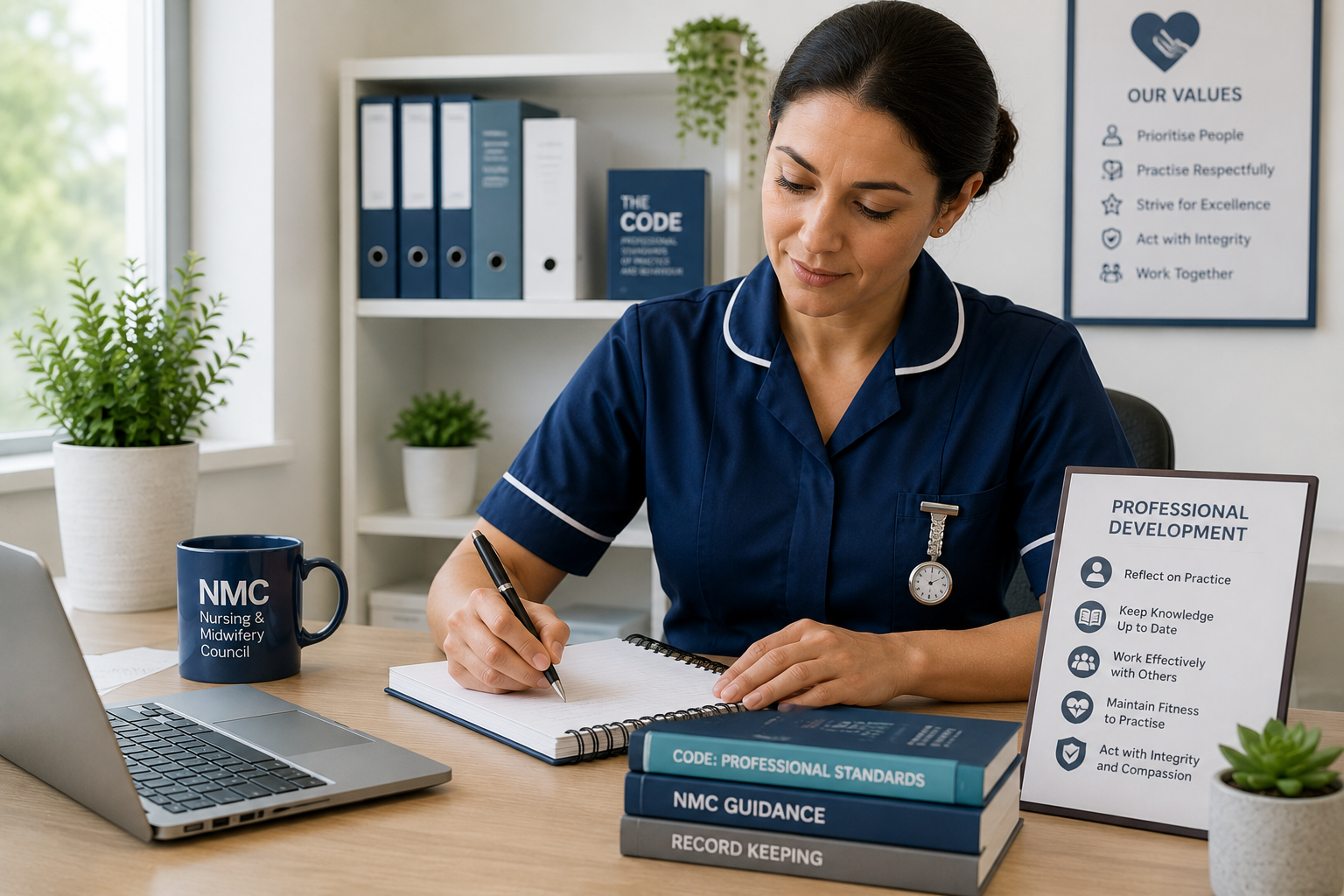
Professional standards are the expectations that guide how nurses practise, communicate, and conduct themselves both inside and outside the workplace.
These standards help ensure that patients receive safe, respectful, and high-quality care regardless of the healthcare setting.
Professional standards are influenced by:
The NMC Code
Evidence-based clinical practice
National healthcare guidance
Employer policies and procedures
Ethical principles
Continuing professional development (CPD)
Clinical governance frameworks
Together, these elements create a framework for consistent and accountable nursing practice.
The Importance of the NMC Code
The NMC Code provides the professional and ethical framework that all registered nurses, midwives, and nursing associates are expected to follow.
It is structured around four key themes:
Prioritize People
Patients should always be treated with dignity, kindness, compassion, and respect. Nurses must place the needs of those receiving care at the centre of every decision.
Practize Effectively
Healthcare professionals should maintain clinical competence, communicate clearly, keep accurate records, and work collaboratively with colleagues to deliver safe care.
Preserve Safety
Protecting patients from avoidable harm is a fundamental professional duty. This includes recognising deterioration, escalating concerns, managing risks, and maintaining safe clinical practice.
Promote Professionalism and Trust
Nurses represent a trusted profession. Acting honestly, ethically, and responsibly helps maintain public confidence in healthcare.
Continuing Professional Development (CPD)
Healthcare continues to evolve, and nurses must continually develop their knowledge and skills throughout their careers.
Continuing Professional Development helps nurses:
Maintain clinical competence
Learn new evidence-based practices
Improve patient outcomes
Develop leadership skills
Adapt to changes in healthcare
Prepare for career progression
Meet professional revalidation requirements
CPD may include formal education, conferences, online learning, simulation training, clinical supervision, and reflective practice.
The Value of Reflective Practice
Reflection is an essential part of professional development.
Reflective practice encourages nurses to examine their experiences, identify learning opportunities, and continuously improve the quality of care they provide.
Effective reflection involves considering:
What happened?
Why did it happen?
What went well?
What could have been improved?
What changes should be made in future practice?
Reflection supports safer clinical decision-making and demonstrates professional insight.
Effective Communication
Strong communication is central to professional nursing practice.
Nurses communicate with:
Patients
Families
Doctors
Allied health professionals
Community teams
Care providers
Clear communication reduces misunderstandings, improves patient safety, and supports coordinated multidisciplinary care.
Professional communication should always be:
Respectful
Accurate
Timely
Confidential
Patient-centred
Accurate Record Keeping
Documentation remains one of the strongest indicators of professional nursing practice.
Good records should be:
Accurate
Complete
Objective
Legible
Timely
Secure
Clinical records provide evidence of assessments, decisions, interventions, and outcomes, making them essential during complaints, investigations, and legal proceedings.
Maintaining Clinical Competence
Professional standards require nurses to remain competent within their scope of practice.
This includes:
Keeping clinical knowledge up to date
Following evidence-based guidelines
Participating in mandatory training
Seeking supervision where appropriate
Recognising personal limitations
Asking for support when necessary
Safe nursing practice depends on recognising when additional advice or expertise is needed.
Ethical Decision-Making
Nurses frequently encounter situations requiring careful ethical judgment.
Examples include:
Consent to treatment
Confidentiality
Safeguarding concerns
End-of-life care
Mental capacity
Professional boundaries
Ethical practice requires balancing patient autonomy with safety while following legal and professional guidance.
Learning from Incidents
Healthcare organisations encourage open learning rather than blame.
Following incidents, nurses should:
Participate in investigations
Reflect honestly
Identify learning opportunities
Implement improvements
Share learning with colleagues
Contribute to patient safety initiatives
Learning from mistakes strengthens both individual practice and healthcare systems.
Professionalism Beyond the Workplace
Professional standards extend beyond clinical settings.
Healthcare professionals should also demonstrate professionalism when:
Using social media
Communicating electronically
Attending professional events
Representing their employer
Engaging with the public
Maintaining respectful and responsible behaviour helps preserve trust in the nursing profession.
When Professional Standards Are Questioned
Concerns regarding professional standards may arise through:
Patient complaints
Employer investigations
Serious incidents
Clinical negligence claims
NMC referrals
Coroner's investigations
In complex cases, independent nursing expert witnesses may be instructed to assess whether professional standards were met.
The Role of Nursing Expert Witnesses
Nursing expert witnesses assist by:
Reviewing clinical records
Assessing nursing care objectively
Evaluating compliance with professional standards
Preparing independent expert reports
Explaining clinical issues to solicitors and tribunals
Their evidence supports fair and informed decision-making during regulatory and legal proceedings.
Conclusion
Maintaining professional standards is a lifelong responsibility that extends far beyond initial nursing registration. By committing to continuous learning, reflective practice, ethical decision-making, and evidence-based care, nurses not only improve patient outcomes but also protect their professional reputation and registration.
High professional standards underpin every aspect of nursing practice, from communication and documentation to clinical decision-making and leadership. When concerns arise, independent nursing expert witnesses provide valuable insight into whether those standards have been met, helping courts, employers, and regulatory bodies reach fair, objective, and evidence-based decisions.
Ultimately, professionalism is not measured by avoiding mistakes—it is demonstrated through integrity, accountability, compassion, and an ongoing commitment to delivering the highest standards of patient care.
FAQs
What is an expert nurse witness?
An expert nurse witness is a qualified nursing professional who provides independent, impartial opinions in legal cases. Their role is to review clinical records, assess whether accepted standards of nursing care were met, and prepare expert reports for courts, solicitors, insurers, and tribunals.
What does a nursing expert witness do?
A nursing expert witness provides independent opinion on nursing care, standards, practice and professional issues relevant to legal proceedings.
Are you a referral agency or middleman?
No. We are not a referral agency or middleman. Instructions are handled directly by nursing experts within Expert Nurse Witness Group.
Are your experts registered with the Nursing and Midwifery Council?
Yes. All nursing experts within the group are registered with the Nursing and Midwifery Council and work within their professional scope of practice.
Can we request an expert CV?
Yes. We do not publish individual expert profiles as standard, but a relevant expert CV can be provided on request once the instruction has been reviewed and suitability has been confirmed.
Why do you not publish individual expert profiles?
We recognize that our nursing experts have a right to professional privacy and personal data protection. We therefore do not publish individual profiles as standard. This is in line with data protection principles, including only sharing relevant information where there is a clear professional purpose. A relevant CV can be provided on request once suitability has been confirmed.
Do your experts understand their duty to the court?
Yes. Our experts understand that their overriding duty is to the court and that this duty is independent of the party instructing them.
Can you provide mental capacity and best interests reports?
Yes. We can provide nursing expert opinion on mental capacity and best interests matters where the issues fall within nursing expertise.
What is a quantum care report?
A quantum care report evaluates a person's current and future care requirements following injury or illness. It helps quantify care needs for legal proceedings.
Can you provide quantum care reports?
Yes. We can provide quantum care reports, care cost opinions and future care needs reports where the issues fall within nursing expertise and are supported by the evidence.
Do you cover the whole of the UK?
Yes. We provide UK-wide nursing expert witness services, with remote consultations and assessments available where appropriate.
How long does it take to prepare an expert report?
Timeframes vary depending on the complexity of the case and the volume of records. We will provide an estimated turnaround time once instructions have been reviewed.
What happens after I submit an enquiry?
Once we receive your enquiry, we will review the information provided, discuss your requirements if needed, and advise on availability, scope of work, and the next steps.