

How Expert Witnesses Assist in Professional Regulation Cases
Introduction
Professional regulation plays a crucial role in maintaining public confidence in the nursing profession. When concerns are raised about a nurse's clinical practice, professional conduct, or competence, regulatory bodies such as the Nursing and Midwifery Council (NMC) may investigate whether the registrant's fitness to practise has been impaired.
Many professional regulation cases involve highly technical clinical issues that require specialist nursing knowledge. Solicitors, regulatory panels, employers, and tribunals may not always have the clinical expertise needed to interpret complex nursing records or evaluate whether care met accepted professional standards.
This is where an independent nursing expert witness becomes invaluable. By providing impartial, evidence-based opinions, nursing experts help decision-makers understand the clinical aspects of a case and ensure that proceedings are informed by current professional practice rather than opinion or assumption.
What Is a Nursing Expert Witness?
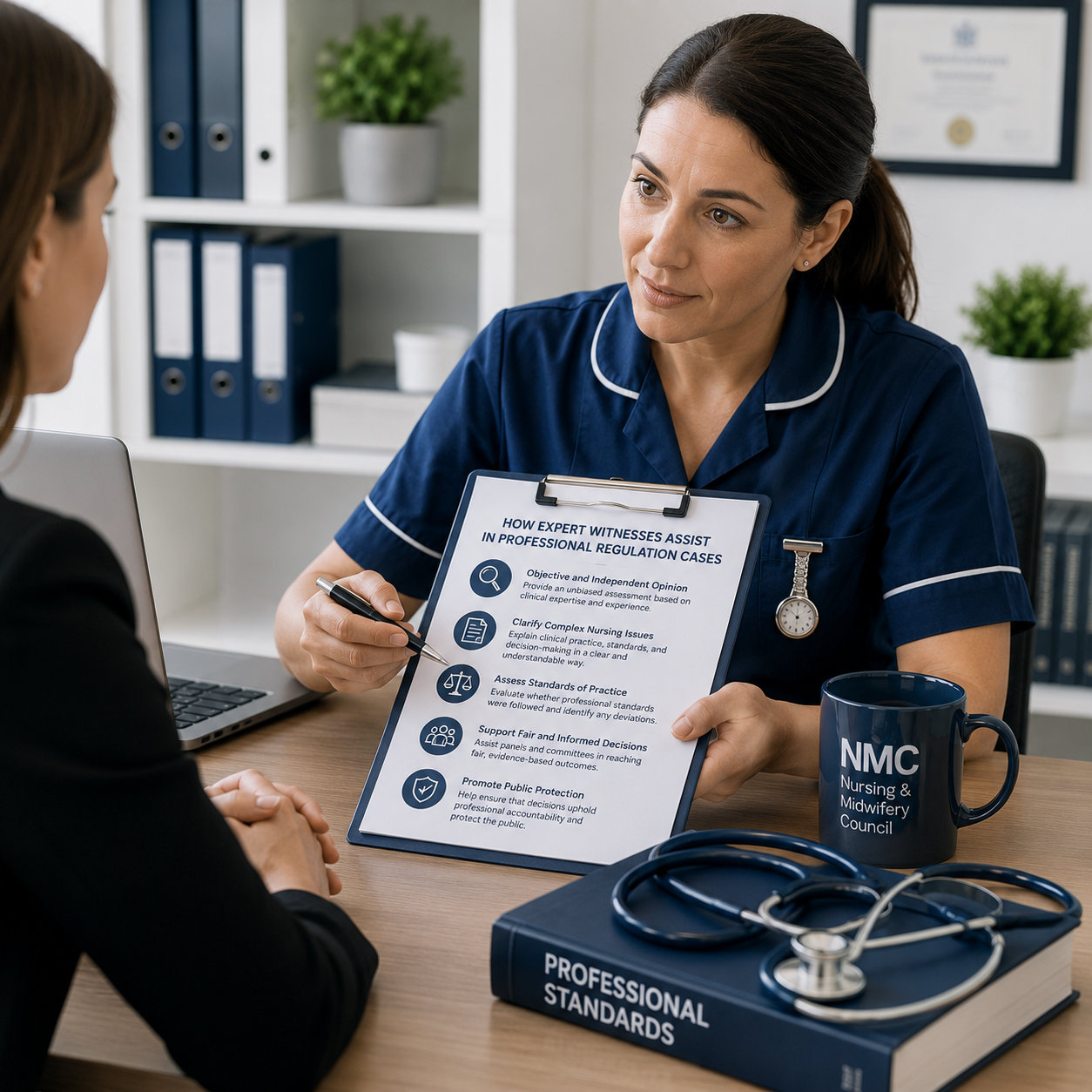
A nursing expert witness is an experienced registered nurse with extensive clinical expertise and knowledge of medico-legal practice.
Unlike factual witnesses, who describe events they personally observed, an expert witness provides an independent professional opinion based on:
Clinical knowledge
Professional experience
Evidence-based practice
Medical and nursing records
National guidance
Professional standards
Their primary responsibility is to assist the court or tribunal, not the party who instructs them.
Why Expert Evidence Is Needed in Regulatory Cases
Professional regulation cases can involve complex questions that extend beyond factual evidence.
Examples include:
Did the nursing care meet accepted professional standards?
Were appropriate clinical decisions made?
Was patient deterioration recognised appropriately?
Did documentation meet professional expectations?
Were accepted nursing procedures followed?
Was the registrant's clinical judgment reasonable in the circumstances?
Independent nursing experts help answer these questions using objective clinical analysis.
Types of Professional Regulation Cases
Nursing experts may become involved in a wide range of regulatory proceedings.
These include:
NMC Fitness to Practise investigations
Professional misconduct allegations
Clinical competence concerns
Record keeping investigations
Patient safety incidents
Medication errors
Safeguarding investigations
Employer disciplinary proceedings
Independent healthcare investigations
Although every case is different, the expert's role remains consistent—to provide impartial clinical evidence.
Reviewing Clinical Documentation
One of the expert witness's first tasks is to review all relevant documentation.
This may include:
Nursing records
Medical notes
Observation charts
Medication administration records
Incident reports
Employer investigation reports
Witness statements
Policies and procedures
Professional guidance
Training records
The expert carefully examines the available evidence before forming an opinion.
Assessing Professional Standards
An important part of the assessment involves comparing the registrant's actions against accepted professional standards.
This may involve consideration of:
The NMC Code
Evidence-based nursing practice
Local organisational policies
National clinical guidelines
Accepted nursing procedures
Professional expectations at the time of the incident
The expert considers whether another reasonably competent nurse working in similar circumstances would likely have acted in the same way.
Providing Independent Expert Reports
Following their review, the nursing expert prepares a detailed medico-legal report.
The report generally includes:
Background information
Instructions received
Documents reviewed
Clinical chronology
Analysis of nursing care
Professional opinion
Conclusions
Statement of truth
The report should be clear, balanced, and supported by evidence rather than speculation.
Explaining Complex Clinical Issues
Healthcare cases often involve specialised terminology and complex nursing procedures.
An experienced nursing expert helps explain issues such as:
Clinical assessment
Escalation of care
Medication administration
Pressure ulcer prevention
Risk assessments
Infection prevention
Documentation standards
Clinical decision-making
Presenting this information in clear, accessible language assists tribunals and legal professionals in understanding the evidence.
Attending Hearings
Although many cases are resolved without oral evidence, nursing experts may attend hearings where required.
During proceedings, they may:
Explain their report
Clarify technical nursing issues
Answer questions from legal representatives
Respond to the tribunal's enquiries
Discuss professional standards
Their role is to assist the decision-making process rather than advocate for any party.
The Importance of Independence
Independence is one of the most important principles governing expert witness work.
Regardless of who instructs them, the nursing expert must:
Remain objective
Present balanced opinions
Consider all available evidence
Identify limitations where appropriate
Acknowledge differing professional views where relevant
Courts and tribunals place significant value on expert evidence that is impartial and evidence-based.
How Expert Evidence Benefits Solicitors
Solicitors frequently rely on nursing experts throughout professional regulation proceedings.
Expert evidence can help:
Assess the strengths and weaknesses of a case
Clarify technical clinical issues
Prepare legal arguments
Identify areas requiring further investigation
Support settlement discussions where appropriate
Assist during hearings
Early expert involvement often improves case preparation and strategic decision-making.
Supporting Fair Regulatory Outcomes
The purpose of expert evidence is not to determine guilt or innocence.
Instead, independent nursing experts help ensure that decisions are based on:
Accurate clinical evidence
Current professional standards
Objective analysis
Established nursing practice
This supports fair outcomes for registrants while maintaining public confidence in the regulatory process.
Conclusion
Professional regulation cases often involve complex clinical questions that require independent specialist knowledge. Nursing expert witnesses provide objective, evidence-based opinions that help solicitors, employers, regulatory panels, and tribunals understand whether nursing care met accepted professional standards.
By reviewing clinical records, analysing decision-making, preparing detailed expert reports, and explaining technical nursing issues clearly, expert witnesses make an important contribution to fair, transparent, and informed regulatory proceedings. Their expertise supports both patient safety and professional accountability, ensuring that decisions are grounded in sound clinical practice rather than assumption.
FAQs
What is an expert nurse witness?
An expert nurse witness is a qualified nursing professional who provides independent, impartial opinions in legal cases. Their role is to review clinical records, assess whether accepted standards of nursing care were met, and prepare expert reports for courts, solicitors, insurers, and tribunals.
What does a nursing expert witness do?
A nursing expert witness provides independent opinion on nursing care, standards, practice and professional issues relevant to legal proceedings.
Are you a referral agency or middleman?
No. We are not a referral agency or middleman. Instructions are handled directly by nursing experts within Expert Nurse Witness Group.
Are your experts registered with the Nursing and Midwifery Council?
Yes. All nursing experts within the group are registered with the Nursing and Midwifery Council and work within their professional scope of practice.
Can we request an expert CV?
Yes. We do not publish individual expert profiles as standard, but a relevant expert CV can be provided on request once the instruction has been reviewed and suitability has been confirmed.
Why do you not publish individual expert profiles?
We recognize that our nursing experts have a right to professional privacy and personal data protection. We therefore do not publish individual profiles as standard. This is in line with data protection principles, including only sharing relevant information where there is a clear professional purpose. A relevant CV can be provided on request once suitability has been confirmed.
Do your experts understand their duty to the court?
Yes. Our experts understand that their overriding duty is to the court and that this duty is independent of the party instructing them.
Can you provide mental capacity and best interests reports?
Yes. We can provide nursing expert opinion on mental capacity and best interests matters where the issues fall within nursing expertise.
What is a quantum care report?
A quantum care report evaluates a person's current and future care requirements following injury or illness. It helps quantify care needs for legal proceedings.
Can you provide quantum care reports?
Yes. We can provide quantum care reports, care cost opinions and future care needs reports where the issues fall within nursing expertise and are supported by the evidence.
Do you cover the whole of the UK?
Yes. We provide UK-wide nursing expert witness services, with remote consultations and assessments available where appropriate.
How long does it take to prepare an expert report?
Timeframes vary depending on the complexity of the case and the volume of records. We will provide an estimated turnaround time once instructions have been reviewed.
What happens after I submit an enquiry?
Once we receive your enquiry, we will review the information provided, discuss your requirements if needed, and advise on availability, scope of work, and the next steps.