

The Nurse's Duty of Care in Clinical Negligence Cases
Introduction
Every registered nurse owes a duty of care to the patients they support. This legal and professional obligation requires nurses to provide care that meets accepted standards, promotes patient safety, and minimises avoidable harm. Duty of care is one of the fundamental principles underpinning modern nursing practice and is central to many clinical negligence claims.
When concerns arise about the quality of nursing care, courts rely on independent expert evidence to determine whether the duty of care was met. Nursing expert witnesses assess the care provided, compare it with accepted professional standards, and provide objective opinions that assist solicitors and the courts in reaching fair decisions.
Understanding what duty of care means, and how it is assessed, is essential for legal professionals, healthcare organisations, and nurses alike.
What Is a Duty of Care?
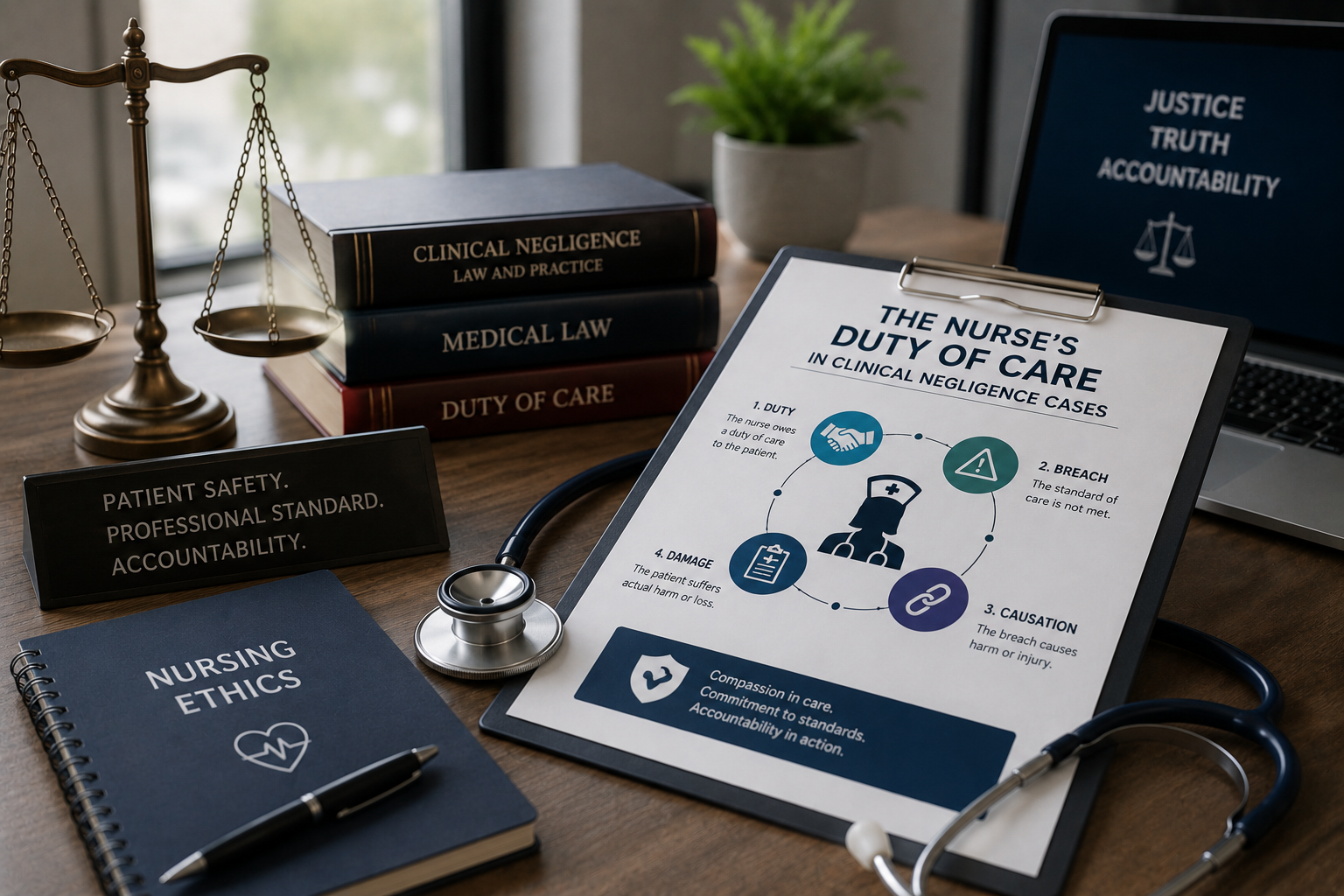
A duty of care is the legal obligation to take reasonable steps to protect patients from foreseeable harm while delivering healthcare.
For nurses, this means providing care that is:
Safe
Competent
Compassionate
Evidence-based
Patient-centred
Consistent with professional standards
The duty exists whenever a professional relationship is established between the nurse and the patient.
Professional Responsibilities
A nurse's duty of care extends beyond clinical tasks.
It includes responsibilities such as:
Assessing patients appropriately
Monitoring changes in condition
Escalating concerns promptly
Administering medication safely
Maintaining accurate records
Communicating effectively
Respecting dignity and confidentiality
Following professional guidance
Meeting these responsibilities helps reduce the risk of avoidable harm.
When Can a Duty of Care Be Breached?
A breach of duty may occur if the standard of nursing care falls below what would reasonably be expected from a competent nurse working in similar circumstances.
Examples may include:
Failure to recognise patient deterioration
Delayed escalation of concerns
Medication errors
Inadequate patient monitoring
Poor pressure ulcer prevention
Failure to complete risk assessments
Incorrect documentation
Failure to follow care plans
Poor infection prevention practices
Not every mistake amounts to negligence. The key question is whether the care provided fell below accepted professional standards.
How Is the Standard of Care Assessed?
The standard of care is assessed by considering what a reasonably competent nurse with similar training and experience would have done in the same circumstances.
Factors considered include:
The patient's condition
Clinical information available at the time
Relevant national guidance
Local policies
Available resources
Accepted nursing practice
Importantly, care is judged based on the information available at the time of the incident—not with the benefit of hindsight.
The Role of Nursing Expert Witnesses
Independent nursing expert witnesses play a vital role in duty of care assessments.
They review:
Nursing records
Medical documentation
Observation charts
Care plans
Medication records
Witness statements
Policies and procedures
Following a detailed review, they provide an impartial opinion on whether the nursing care met accepted professional standards.
Establishing Clinical Negligence
A successful clinical negligence claim generally requires more than demonstrating that an error occurred.
The claimant must establish:
Duty of Care
That the healthcare professional owed a duty to the patient.
Breach of Duty
That the standard of care fell below what would reasonably be expected.
Causation
That the breach directly caused or materially contributed to the patient's injury or loss.
Damage
That the patient suffered harm as a result.
Nursing expert evidence frequently assists in assessing both breach of duty and, where appropriate, issues relating to causation.
Common Cases Involving Nursing Duty of Care
Duty of care issues may arise in many healthcare settings, including:
NHS hospitals
Private hospitals
Community nursing
Care homes
Mental health services
Maternity services
District nursing
Rehabilitation services
Hospice care
Each setting presents unique challenges that require careful consideration of accepted nursing practice.
Why Documentation Matters
Clinical documentation often provides the strongest evidence when assessing whether a duty of care was fulfilled.
Good records should demonstrate:
Timely assessments
Appropriate interventions
Escalation of concerns
Patient observations
Communication with colleagues
Evaluation of care
Incomplete documentation can make it difficult to establish exactly what care was delivered.
Preventing Breaches of Duty
Healthcare organisations and professionals can reduce risk by:
Maintaining professional competence
Following evidence-based guidance
Completing mandatory training
Encouraging effective communication
Promoting accurate documentation
Supporting adequate staffing
Learning from patient safety incidents
Continuous improvement strengthens patient safety and professional practice.
Conclusion
A nurse's duty of care is at the heart of safe, professional, and compassionate healthcare. By delivering evidence-based care, maintaining accurate records, recognising deterioration, and communicating effectively, nurses help protect patients from avoidable harm while meeting their professional obligations.
When concerns arise regarding the quality of care, independent nursing expert witnesses provide essential clinical insight. Their objective assessments assist solicitors, insurers, and the courts in determining whether accepted nursing standards were met, ensuring that clinical negligence claims are decided fairly and on the basis of sound professional evidence.
FAQs
What is an expert nurse witness?
An expert nurse witness is a qualified nursing professional who provides independent, impartial opinions in legal cases. Their role is to review clinical records, assess whether accepted standards of nursing care were met, and prepare expert reports for courts, solicitors, insurers, and tribunals.
What does a nursing expert witness do?
A nursing expert witness provides independent opinion on nursing care, standards, practice and professional issues relevant to legal proceedings.
Are you a referral agency or middleman?
No. We are not a referral agency or middleman. Instructions are handled directly by nursing experts within Expert Nurse Witness Group.
Are your experts registered with the Nursing and Midwifery Council?
Yes. All nursing experts within the group are registered with the Nursing and Midwifery Council and work within their professional scope of practice.
Can we request an expert CV?
Yes. We do not publish individual expert profiles as standard, but a relevant expert CV can be provided on request once the instruction has been reviewed and suitability has been confirmed.
Why do you not publish individual expert profiles?
We recognize that our nursing experts have a right to professional privacy and personal data protection. We therefore do not publish individual profiles as standard. This is in line with data protection principles, including only sharing relevant information where there is a clear professional purpose. A relevant CV can be provided on request once suitability has been confirmed.
Do your experts understand their duty to the court?
Yes. Our experts understand that their overriding duty is to the court and that this duty is independent of the party instructing them.
Can you provide mental capacity and best interests reports?
Yes. We can provide nursing expert opinion on mental capacity and best interests matters where the issues fall within nursing expertise.
What is a quantum care report?
A quantum care report evaluates a person's current and future care requirements following injury or illness. It helps quantify care needs for legal proceedings.
Can you provide quantum care reports?
Yes. We can provide quantum care reports, care cost opinions and future care needs reports where the issues fall within nursing expertise and are supported by the evidence.
Do you cover the whole of the UK?
Yes. We provide UK-wide nursing expert witness services, with remote consultations and assessments available where appropriate.
How long does it take to prepare an expert report?
Timeframes vary depending on the complexity of the case and the volume of records. We will provide an estimated turnaround time once instructions have been reviewed.
What happens after I submit an enquiry?
Once we receive your enquiry, we will review the information provided, discuss your requirements if needed, and advise on availability, scope of work, and the next steps.